
Scottish Interventional Cardiology
Nursing & Allied Professions
Sharing practice & experience
News:
Keep up to date with all the current developments and topical news relating to cardiology and heart disease from around Scotland and further a field.
Please keep in contact at sicnap@mail.com to share any local news or events you may be involved with and we will be happy to spread the word with all our SICNAP followers to ensure we all keep on benefitting from the 'Sharing practice & experience'
June 2014
Golden Jubilee National Hospital, Glasgow. UK Fastest Door to Balloon Time for STEMI
The Golden Jubilee National Hospital, is leading the UK with the fastest delivery times for potentially lifesaving treatment for heart attack patients. The figures, from the National Cardiac Benchmarking Collaborative, measure the time taken for a patient to receive Primary Percutaneous Coronary Intervention (PPCI) – also known as Balloon Angioplasty – from the moment they enter a hospital. Fast and effective PPCI – or ‘Door to Balloon’ treatment – improves the chances of survival and reduces the likelihood of permanent damage for heart attack patients. This process now takes just 21 minutes from the time a patient arrives at the Golden Jubilee’s front door.
Health Secretary Alex Neil has hailed the "outstanding" staff at the Golden Jubilee National Hospital. “As a major heart and lung centre, the Golden Jubilee has an outstanding track record in ‘Door to Balloon’ treatment times - leading the UK on this treatment is a remarkable achievement. The fact this process takes just 21 minutes is a tribute to the dedication and drive for improvement we see not only from staff at the Golden Jubilee, but across Scotland’s NHS".
Jill Young, Chief Executive of the Golden Jubilee National Hospital, said “As home to Scotland’s specialist centre for adult heart conditions, our team respond to complex critical cases on a daily basis. As a result, we now provide a world-class standard of care for every patient who comes to us for treatment; having the fastest Door to Balloon time in the UK is a testament to the skill, dedication and expertise of our team".
http://www.nhsgoldenjubilee.co.uk/news/press-releases-2014/uks-fastest-heart-attack-treatment/
http://news.scotland.gov.uk/News/UK-s-fastest-heart-attack-treatment-e39.aspx
August 2013
Raigmore Hospital, Inverness. NHS Highland Optimal Reperfusion Service & STEMI Management.
The team at the Cardiac Unit in the Highlands of Scotland outline the challenges and opportunities of providing acute cardiac care in the most remote part of the UK. Early diagnosis and referral to the Coronary Care Unit is the critical first step in deciding if a patient with a heart attack should receive emergency clot busting drug in the community or taken immediately to hospital.
This video reinforces the need for close team working between pre-hospital and hospital staff.
The development of coronary angioplasty at the cath lab at Raigmore hospital and the excellent pre-hospital care by GPs and the ambulance service mean that world class treatment is now possible for the vast majority of patients in this area who unfortunate enough to suffer a heart attack.
April 2013
British Heart Foundation- Mending Broken Hearts Appeal.
The search for a cure is happening now. When you have a heart attack, a portion of your heart muscle is damaged and dies. At the moment, once your heart is damaged, you will live with that damage for the rest of your life – it cannot be reversed.
The British Heart Foundation is the biggest independent funder of heart research in the UK. Now because of recent advances in regenerative medicine, there is real hope for a cure. Every day our scientists are getting closer to understanding how to repair the damage caused by heart attack and they have already made some astonishing breakthroughs.
Our researchers can already make heart cells in the lab using stem cells. Stem cells have the potential to lead to a new treatment for heart failure.
The Golden Jubilee National Hospital, home to the Scottish National Advanced Heart Failure Service (SNAHFS), will participate in one of two trials announced by the British Heart Foundation. Along with the Royal Brompton Hospital, the UK recruitment centres for this multi-centre, international trial, aim to recruit 200 patients who have severe chronic heart failure and are currently on ‘optimal’ treatment.

March 2013
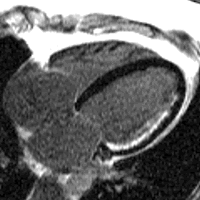
DEFER STEMI
During primary PCI, stent deployment and post-dilatation can be associated with no-reflow. No reflow is associated with risk factors such as prolonged duration of ischaemia, heavy thrombus burden, persistent ST elevation and long stent length.
HYPOTHESIS: once normal antegrade flow has been re-established with initial aspiration thrombectomy and/or balloon angioplasty at the beginning of primary PCI, compared with usual care with direct stenting, a strategy of deferred stenting for 4 -16 hours to permit the beneficial effects of normalized coronary blood flow and anti-thrombotic therapies will reduce the incidence of no reflow in at-risk STEMI patients.
DESIGN: In consecutive STEMI patients with risk factors for no reflow and who have given informed consent, when normal flow has been established (TIMI 3) by initial aspiration thrombectomy and/or balloon angioplasty, participants will be randomized to deferred stenting or usual care with direct stenting.
Recruitment is now complete and data analysis is in progress. Results will be published in due course.
http://clinicaltrials.gov/show/NCT01717573
March 2013
A documentary about how the London Ambulance Service, LAS, has improved survival rates for patients suffering cardiac arrest or heart attack.
Thousands of people every year in London suffer cardiac arrest or a heart attack. They stand the best chance of survival by getting fast and effective emergency medical care.
Over the last 10 years the London Ambulance Service has worked hard to improve out-of-hospital cardiac arrest survival rates in the capital, and takes patients suffering a common type of heart attack known as STEMI, directly to specialist cardiology teams for the best level of care.
The documentary, Code STEMI, features real-life patients telling their stories in their own words, and interviews with leading paramedics and cardiologists.
February 2013
SIGN 93 Acute Coronary Syndromes covers the assessment, emergency care and management of patients with unstable angina and myocardial infarction. Evidence on reperfusion therapies and ongoing pharmacological management is presented. The guideline also provides information on risk
stratification and management of complications.
Since publication of SIGN 93 in 2007, new evidence has been published around the time-dependent benefits of reperfusion strategies for the immediate management of patients with ST elevation acute coronary syndromes.
Following examination of updated evidence around optimal timing for delivery of primary percutaneous coronary intervention (pPCI), the guideline group developed a revised recommendation in line with new European consensus guidelines, and incorporated two new good practice points.
Patients with an ST elevation acute coronary syndrome should be treated immediately with primary
percutaneous coronary intervention.
When primary percutaneous coronary intervention cannot be provided within 120 minutes of
ECG diagnosis, patients with an ST elevation acute coronary syndrome should receive immediate
thrombolytic therapy.
This guideline will now be put before each of the Regional Planning Groups for implementation. SIGN believes implementation of the guideline will maximise the number of patients who may have access to the safest and most effective treatment.

December 2012
Seven patients who were too ill to have open heart surgery have now received Transcatheter Aortic Valve Implantation (TAVI) at the Royal Infirmary of Edinburgh centre,It is expected that the specialist operation will be suitable for around 50 Scottish patients a year.
If a patient is either not well enough for open heart surgery, or their heart and vessels are not suitable for replacement, TAVI can be used as an alternative treatment option if suitable.
Clinical Director for Cardiac Services NHS Lothian Dr Neal Uren said: "The service has begun making a real difference to the lives of patients already and we are delighted to see how well they have recovered. "Without this procedure, these patients would not have been able to undergo treatment and their quality of life would continue to diminish.
TAVI was already available to Scottish patients on a case by case basis, with patients who are considered suitable being referred by their local Health Board to an appropriate provider outwith Scotland. Fifteen Scottish patients were referred for TAVI in 2011.
The new service will be closely monitored over the next six to 12 months, and consideration will be given to introducing a regional model of service, or extending to two sites.
http://www.scotland.gov.uk/News/Releases/2012/12/tavi5dec
December 2012
An unusual research project we fund at the University of Edinburgh is looking for clues about the causes of heart attacks – by working with firefighters on duty.
The £187,000 project, which is possible thanks to donations from our supporters, is a unique collaboration with Lothian and Borders Fire Service. Scientists are following the firefighters during fire training, when they tackle blazes at up to 700 degrees Celsius, to work out the effect their job has on the heart.
The reason for the project is that firefighters are more likely to suffer from a heart attack on duty than at other times. We don’t yet fully understand why, but it’s likely to be a combination of the heat and different stresses put on the body when fighting fire.
The researchers are taking measurements of the heart and blood vessels of firefighters before they tackle a blaze at their Edinburgh training facility.
It’s important to work out how firefighting puts such a strain on the body, because it could help find new ways to look after the health of our firefighters. They risk their lives to keep us safe, so we hope that this research might help us give something back.
October 2012
In response to evidence that some people hesitate to call for medical help when experiencing heart attack symptoms, thereby reducing the chances of a positive patient outcome, the Scottish Ambulane Service is working in partnership with BHF Scotland and CHSS on a chest pain awareness campaign. The campaign is funded by BHF and CHSS and is designed to help save more lives by increasing public awareness of the symptoms of a heart attack, highlighting what actions to take as well as breaking down barriers to calling 999. Two areas have been tested to find out if the campaign is changing behaviour. In NHS Lanarkshire, 16 volunteers were trained to work with communities to build awareness. They have been supported though an online platform, which has enabled them to share good practice. In Fife, bus stop advertising was combined with posters on NHS vans and in GP surgeries, along with leaflets. The local Managed Clinical Network (MCN) also undertook some community awareness activity. As these test campaigns are being evaluated in order to share learning, work is underway to run the campaign in targeted areas of the North Division. One of the key campaign materials is a short film, which features a patient telling his own story of how he suffered a heart attack. His experience is described from the onset of chest pain, to calling 999 and the resulting life-saving care he received from Shotts-based Paramedic Team Leader, Eleanor Keane and Technician, Lisa Clark.
SICNAP acknowledges the vital role the Scottish Ambulance Service provides in the provision of the recognition & management of patients presenting with acute MI. Raising public awareness of the signs and symptoms of heart attack and the need for early contact with the emergency services is vital to ensure timely access to specialist clinical services.
Keep on 'Sharing practice & experience'
September 2012
The Scottish Interventional Cardiology Nursing & Allied Professions forum has just launched. It aims to attract membership from those working directly in interventional cardiology and also those who have a slightly more detached connections. Whatever your link you are most welcome to look around and become a member, free of charge, by sending your details to sicnap@mail.com
We hope that through a membership representative of a selection of clinical disciplines and from across Scotland, and possibly even further afield, we can all learn from each other and develop our insight and knowledge around interventional cardiology.
There are many new and exciting developments taking place in interventional cardiology across Scotland and a few getting ever closer on the horizon.
Transcatheter Aortic-Valve Implantation will soon be performed in the Heart Centre at the New Royal Infirmary of Edinburgh, after the recent announcement by Alex Neil, Health Secretary. We look forward to the benefits this service will provide.
The Scottish Intercollegite Guidelines Network (SIGN) have recenty been reviewing the time window for offering primary PCI to patents presenting with acute STEMI. In response to the new clincal practice guidelines released by the European Society of Cardiology last month, it is anticpated diagnosis to balloon time currently set at 90 minutes will be extended to 120 minutes. Increasing the number of patients eligible to receive optimal reperfusion by primary PCI.
We would be keen to hear of any news members would like to share among the group and encourage you to pass on your information via sicnap@mail.com and we will spread the word.
Keep on 'Sharing practice & experience'
